The “rest of the story” behind the national anthem.
Even as Americans remain divided over politics and current issues, the country is preparing to commemorate the 250th anniversary of the Declaration of Independence, bringing national symbols to the spotlight. Among the most important of these is “The Star-Spangled Banner,” and despite its status as the national anthem, its origins and evolution are not widely known among the American public.
Background
The United States was still a young country when it muddled its way into war with Great Britain in 1812. James Madison was President; there were only 18 states; and the largely volunteer military was, at times, ill-prepared and undisciplined.
And while the U.S. would eventually fight to a draw, preserving the status quo ante bellum, the late summer of 1814 was a harsh one. The British overwhelmed American forces at The Battle of Bladensburg, marched to the nation’s capital, then proceeded to burn the White House and the Capitol building—all in the same day. The control of Washington, D.C. was largely symbolic, but it also served as a prelude to a potential capture of Baltimore, then the nation’s third largest city.
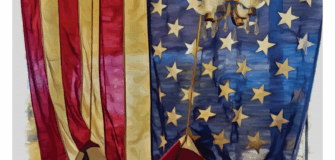
Central to control Baltimore was Fort McHenry, which was commanded by Major George Armistead. Upon taking command in 1813, Armistead requested a flag “so large that the British will have no difficulty in seeing it from a distance.” His request was filled by Mary Pickersgill, who created, according to the receipt, “1 American ensign, 30 x 42 feet, first quality Bunting.”
It was this garrison flag that flew above Fort McHenry in September 1814 when, improbably, the career of a young attorney and amateur poet intersected with history. That attorney was Francis Scott Key.
Key was representing Dr. William Beanes, who was taken captive by the British on charges of espionage. Writing to his mother, Key explained that he would leave by ship with John Skinner, the U.S. Prisoner of War Agent, seek to intercept the British fleet, negotiate the release of “Old Dr. Beanes,” and return within “eight to ten days,” although he closed with a note of uncertainty: “I do not know where to find the fleet.”
Key and Skinner found the British fleet just fine. The ships had amassed near Chesapeake Bay as the British command finalized their plans for an amphibious invasion of Baltimore—which British Vice Admiral Alexander Cochrane referred to, with obvious glee, as “the richest in the Country.”
Against this background, Key and Skinner began negotiations with a distracted British command for the release of Dr. Beanes. It became clear Baltimore was an imminent target, and while negotiations were successful, Vice Admiral Cochrane embargoed the departure of Key, Skinner, and Beanes, noting: “After discussing so freely…in your presence our purposes and plans, you can hardly expect us to let you go ashore now in advance of us.” Literally and figuratively, the American delegation was asea, passive witnesses to the fate of their country.
Defending Fort McHenry
Fresh off easy victories at Bladensburg and Washington, D.C., British General Robert Ross landed 12 miles southeast of Baltimore on September 12, with plans to fight his way to the city by nightfall: “I’ll dine in Baltimore tonight,” Ross boasted, “or in hell.”
Ross did not eat in Baltimore. He was felled by a sniper’s bullet early in the Battle of Baltimore, and the British were left without their North American commander for what historian Tom McMillan referred to as the “most important land-based attack of the War of 1812.”
British progress was slow, eventually stalling against stiff American resistance and bad weather. Faced with a slog by land, the British turned their attention to their Navy and Fort McHenry.
“Control of the Fort,” noted McMillan, “meant control of the city and harbor, regardless of what happened in the ground war.” The naval battle began at 6:30am on September 13, as Vice Admiral Cochrane unleashed the full force of his arsenal. Americans, he said, “like Spaniels…must be treated with great severity before you ever make them tractable.”
British ships fired more than 2,000 shells, cannonballs, and rockets. “We were exposed,” said Armistead, “to a constant and tremendous shower of shells…[but] not a man shrunk from the conflict.” As the day dragged on, the weather worsened, leading to choppy waters and, consequently, less-accurate cannon fire from British ships. When the British attempted to advance and find better range, they were met with a volley of return fire, flying “like hailstones,” and they retreated.
With the onset of night, the British continued their bombardment, including the employment of the newly-invented Congreve Rocket, which produced a shrill whistle and, depending on the length of the fuse, often exploded while in air, producing conflagrations below. This could be terrifying to soldiers, but for Francis Scott Key and other long-distance observers, they provided glimpses—by the rockets’ red glare—into the battle’s progress. These glimpses, however, were not definitive, and it was not until the sun broke the horizon that Key was able to espy “the stars of that banner,” which he described as a “manifest deliverance.” The flag was still there.
By full sunrise, the British were war-weary, and after 25 hours of battle, the last cannon was fired. At 9am, the British were in retreat, vacating the Bay, and a young English seamen recorded his thoughts, “As the last vessel spread her canvas to the wind, the Americans [boasted] a most superb and splendid ensign on their battery, and fired at the same time a gun of defiance.”
The poem; the song; the anthem
While sailing back to port, Francis Scott Key began jotting the words we now know as the national anthem. Indeed, he completed the first draft by landfall on September 16, and following a few refinements, it was printed the next day as “Defence of Fort McHenry,” and within a few months, the title was changed to “The Star-Spangled Banner.”
The poem is four verses, although today’s audiences are likely only familiar with the first verse, and because the song is part of a ritual—often at sports games—its lyrical qualities likely go unnoticed by the American public.
The poem follows a rhyme scheme of A-B-A-B-C-C-D-D, such that the first verse ends with “light,” “gleaming,” “fight,” “streaming,” “air,” “there,” “wave,” brave.” Moreover, the first six words lay out the five long vowel sounds of the alphabet: “O,” “Say,” “You,” “See,” and “By,” which, it’s worth noting, are the most euphonious sounds in the language. The meter relies heavily on anapests (two unstressed syllables, followed by a stressed syllable), giving it a waltz-like rhythm while still being adaptable to other renderings.
Key set these lyrics to the music of “To Anacreon in Heaven”—an English song dating back to 1775, which according to author Marc Ferris was a “bawdy, boozy, ballad,” one with a melody appropriate for various lyrics and speeds. Indeed, Ferris notes that by 1820, the music undergirded “at least eighty-four other compositions.” With Key’s help, it would go from boozy ballad to national anthem.
The road to anthem-hood, however, was long, bumpy, and crowded. At the time Key composed “The Star-Spangled Banner,” two other songs laid some claim to the title of “national tune:” “Hail, Columbia,” and “Yankee Doodle.” Within a few decades, “My Country, ‘Tis of Thee” and “Columbia, Gem of the Ocean” were written and became contenders for a national song.
Some complained that “The Star-Spangled Banner” borrowed its melody from an English song; others complained—especially during Prohibition—that the tune began its life as a “boozy ballad”; still others complained that it was too difficult to sing.
But publications began making references to it as “the national air,” the “national ode,” or the “National American Song.” By the late 19th century, standing and removing headgear was customary when “The Star-Spangled Banner” was performed; the Navy recognized it as its official anthem in 1889; and by the mid-1890s, the song was regularly performed at opening-day baseball games. It was, in all but official name, the national anthem.
Its status as the official national anthem came in 1931, when Congress passed, and President Hoover signed, a joint resolution that is brilliant in its simplicity: “The composition consisting of the words and music known as the Star-Spangled Banner is the national anthem.”
Notable Performances
In recent decades, Americans’ primary exposure to the national anthem is through sporting events—which, in the case of national championships, have transmogrified into spectacles, with celebrities performing, military flyovers, and even celebrity sign language interpreters (e.g., Marlee Matlin has interpreted in two Super Bowls).
Many of these performers have proved equivalent to the occasion. Whitney Houston—performing while the U.S. was at war with Iraq in early 1991—demonstrated her impressive (pre-recorded) vocals at Super Bowl XXV. Beyonce offered an admirably restrained (also lip-synced) version at President Obama’s 2013 Presidential Inauguration. And Chris Stapleton gave a muscular, stripped-down (live) version of the anthem at Super Bowl LVII.
Other performances proved memorable for the wrong reasons. Many performers have forgotten lyrics (e.g., Christina Aguilera at Super Bowl XLV), offered strange interpretations (e.g., Fergie at the 2018 NBA All-Star Game), simply been themselves (Roseanne Barr at a San Diego Padres game), been intoxicated (Ingrid Andress, MLB Home Run Derby), or just weren’t up to the vocal challenge, as in the case of track-star Carl Lewis (at a Chicago Bulls game). In the latter case, the sportscaster Charlie Steiner concluded, “The national anthem, written by Francis Scott Off-Key.”
Coda
“The Star-Spangled Banner,” like the Declaration of Independence, has endured through the country’s wars, political divisions, and cultural changes, continuing to connect Americans to founding concepts such as courage, sacrifice, and freedom. And whether sung pitch-perfect or off-key, the anthem—when approached with understanding and appreciation by performers and audiences—can help make this special July 4th a banner day for the United States.
Which broad stripes and bright stars?
Francis Scott Key expressed relief at seeing the American flag atop Fort McHenry on the morning of September 14, but which flag was it that he saw? It was not the famous Betsy Ross flag, which featured 13 stars and stripes, which by that time had been rendered obsolete. Rather, it was the flag designated in the Flag Act of 1794, which featured 15 alternating stripes and 15 stars. This flag was still in use in 1814, despite the fact that there were 18 states in the union. Moreover, the flag he saw “by the dawn’s early light” was almost certainly the Fort’s “storm flag,” a smaller version of the garrison flag, which as its name suggests, was flown during storms to prevent a heavy, water-soaked flag from breaking the flagpole. This flag was 17 x 25 feet. It is likely, however, that Key caught glimpse of the garrison flag the day before, and it is also possible he caught sight of the flag-hoisting ceremony at the Fort on September 14, which occurred in better weather. The garrison flag is currently on display at the Smithsonian’s National Museum of American History.
Francis Scott Key: File:By Dawn’s Early Light 1912.png – Wikipedia
Mary Pickersgill sewing: File:Placing the Stars.jpg – Wikimedia Commons
The Garrison Flag in 1873: File:Fort McHenry flag.jpg – Wikimedia Commons